
SURFBOAD
DESIGNS
Prefer to listen?
Water Into Movement
Surfboards don’t generate speed on their own.
They don’t decide how a wave breaks.
They don’t move without input.
What they do is shape how water responds to a surfer’s weight, angle, and timing.
Board design isn’t about shortcuts or hidden tricks.
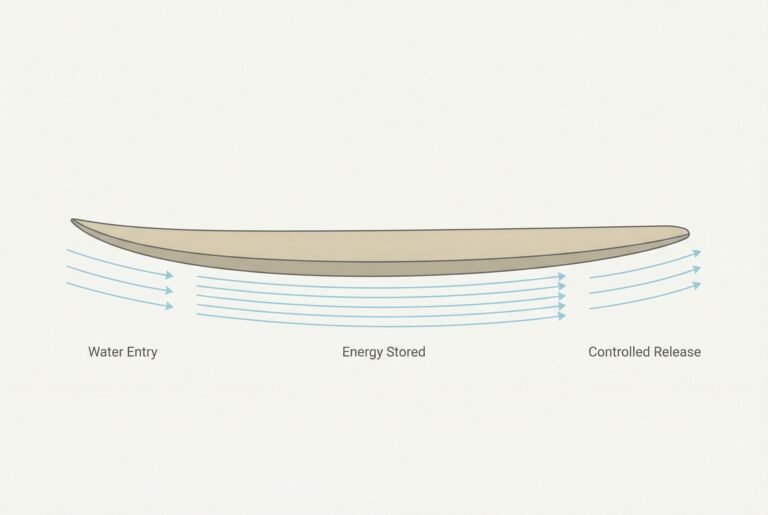
It’s about how energy is accepted, stored, and released as water moves beneath the board.
Fins play a similar role — translating water flow into usable control —
but the board determines how that water arrives in the first place.
Control Before Speed
Boards are often described as fast, loose, or drivey.
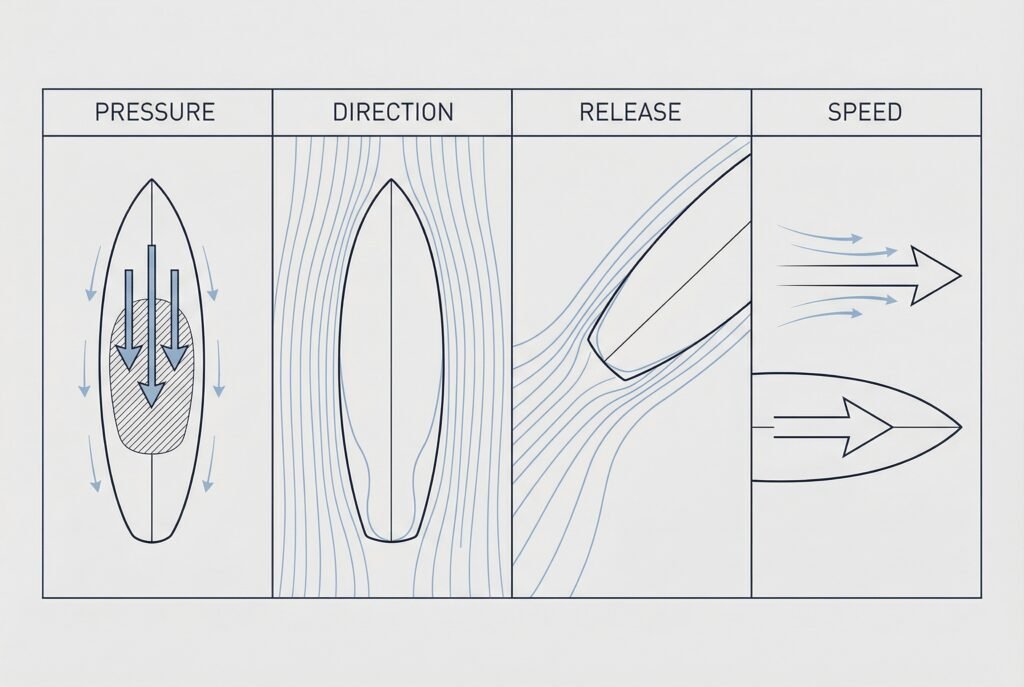
But those sensations rarely come from speed alone. They come from control. A board that feels fast usually:
Releases water cleanly
Accepts pressure without stalling
Returns energy predictably
Speed is not added. It remains when energy is guided and released cleanly
Speed is the outcome. Control is the mechanism.
What’s Happening Beneath the Board
As a board moves across a wave, water flows beneath it.
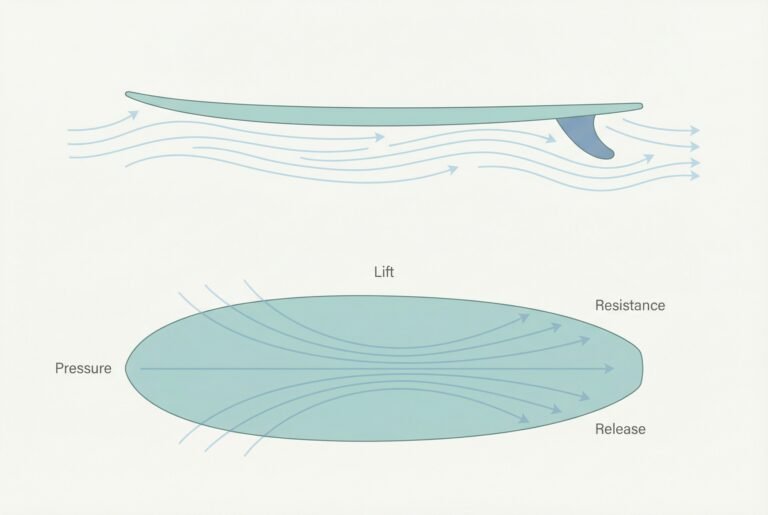
Design decides where that water goes, how pressure builds, and how cleanly it exits.
Every curve and transition influences:
Pressure
Lift
Resistance
Release
Like fins, the board does very little until it is loaded.
Bottom Contours: How Water Is Guided
Most conversations about bottom contours focus on speed.
Flat is clean. Flat is efficient when the water exits cleanly. – Concave can feel faster. Concave can add lift and efficiency when engaged – Vee is smooth.
But bottom contours don’t exist to make boards fast.
They exist to decide how water is allowed to move.
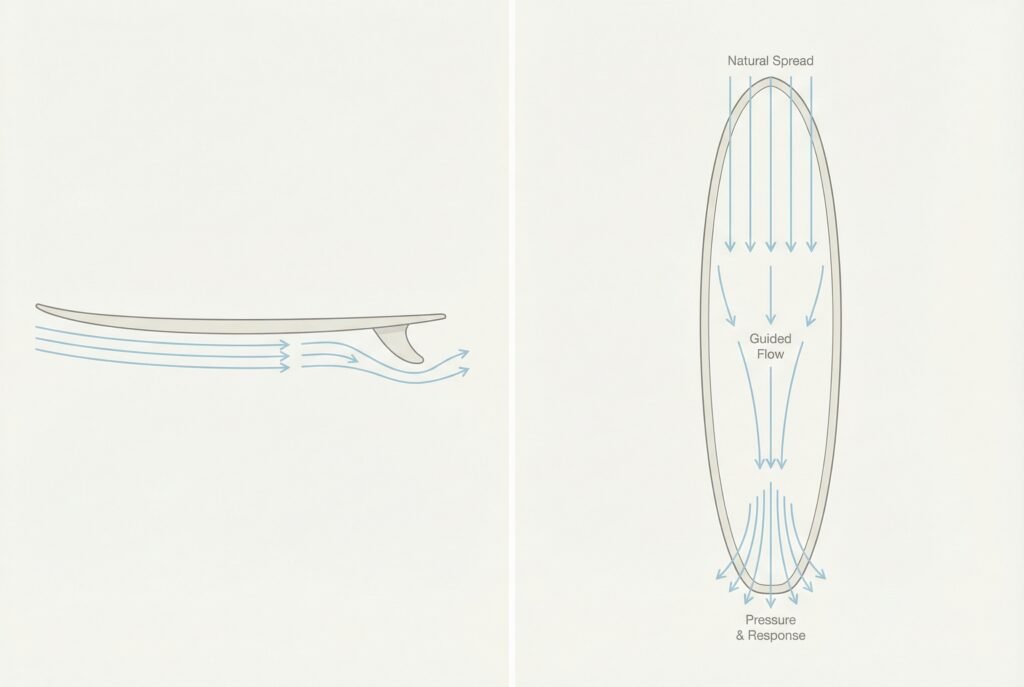
Left alone, water spreads evenly.
It resists sudden direction.
Contours interrupt that behaviour.
They don’t force water forward —
they limit where it can go.
That limitation creates pressure.
Pressure creates response.
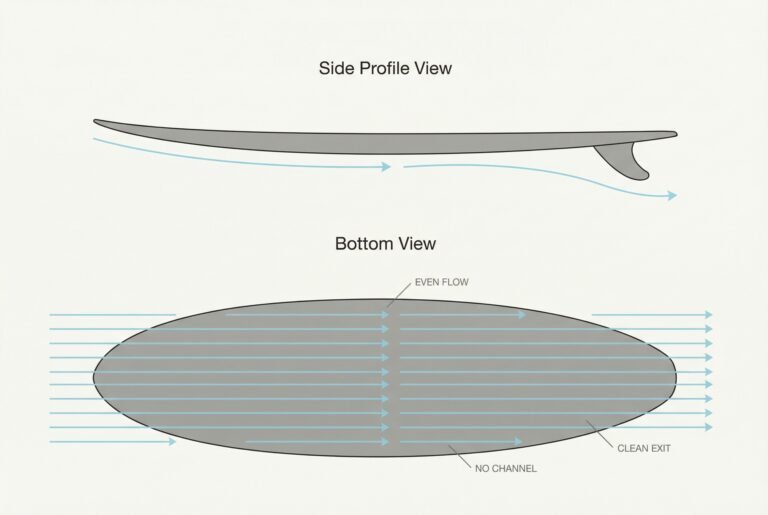
Flat Bottom Surfboard
A flat bottom allows water to pass beneath the board with minimal interruption.
No channel – No focal point – No forced direction.
Water enters, moves, and exits cleanly.
This is why flat bottoms feel predictable and stable. They trim easily and they don’t exaggerate input or hide mistakes. A flat bottom board doesn’t rush you, it waits.
Flat bottoms rarely feel exciting because nothing is amplified.
There is no stored pressure waiting to be released.
What you put in is what you get back.
For some surfers, that feels calm. For others, it feels dull.
Neither is wrong.
Single Concave Surfboard
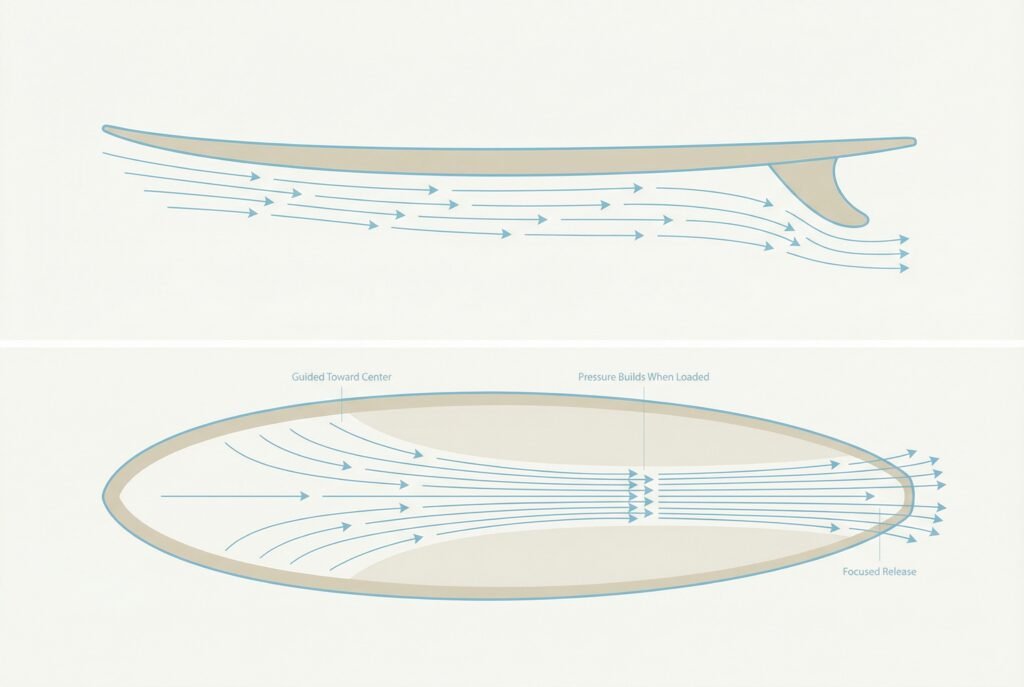
A single concave narrows the path water is allowed to take.
Instead of spreading, water is guided along the centreline.
Pressure builds beneath the board — but only when weight is applied.
This is why single concaves feel lively when engaged and respond strongly to clean technique.
Without pressure, they feel ordinary – With pressure, they wake up.
They can also feel unforgiving when weight placement is unclear or pressure builds unevenly.
Flow breaks.
Drag appears.
A concave doesn’t smooth movement. It magnifies it.
Double Concave Surfboard
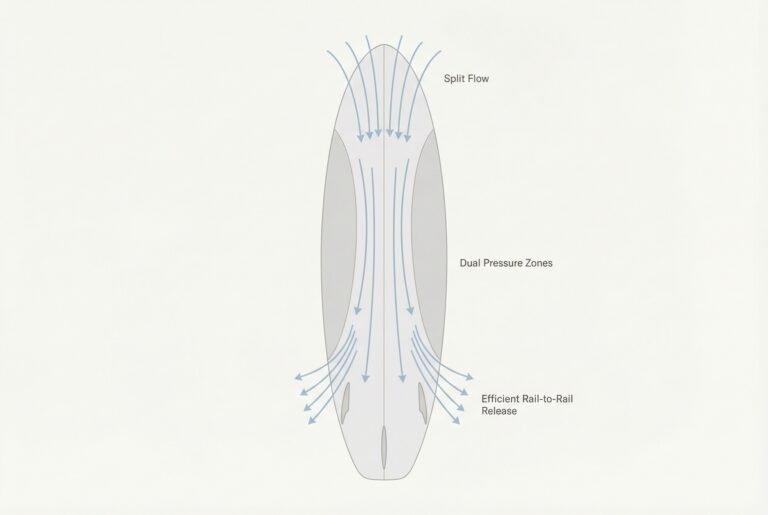
Double concaves split water toward the rails.
Instead of one pressure point, there are two.
Instead of one release path, there are options.
This reduces resistance at higher speeds.
Rail-to-rail transitions feel lighter.
Direction changes feel easier.
Double concaves rarely announce themselves.
They simply feel efficient.
Vee Shape Surfboard
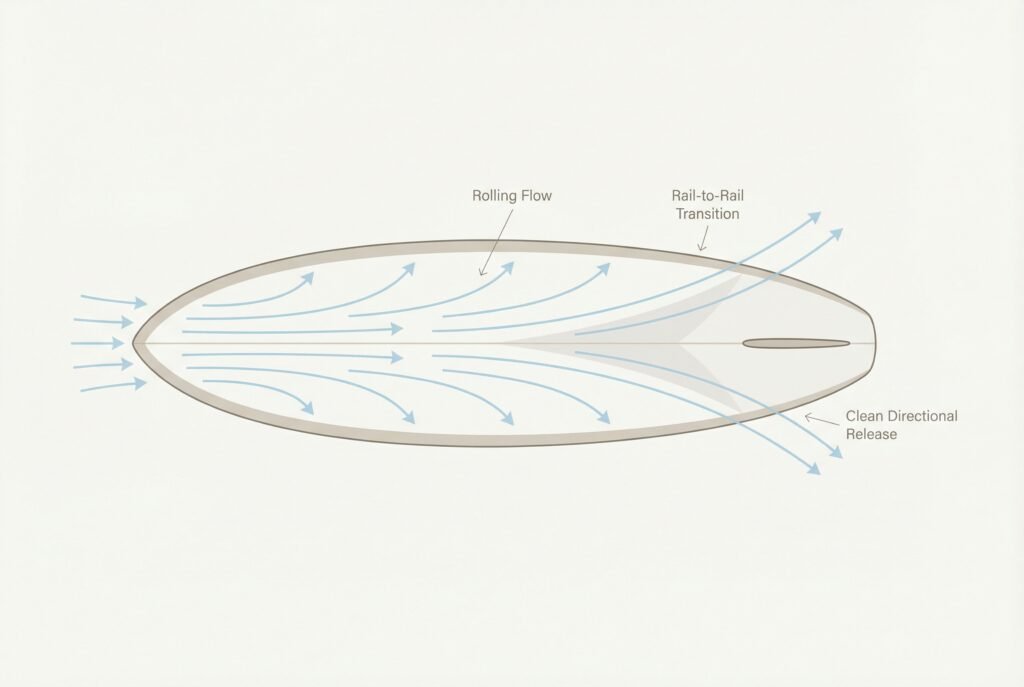
Vee encourages water to roll rather than channel. As weight shifts, the board tips naturally from rail to rail and the water follows that motion.
This softens transitions and slows reactions slightly.
It encourages flow over snap.
Vee doesn’t add control, it removes friction. Vee is often found near the tail because turning requires release.
Through the tail:
Change direction cleanly
Exit turns smoothly
Avoid feeling locked-in
It doesn’t force movement, it allows it.
Why “Flat” Is Rarely Flat
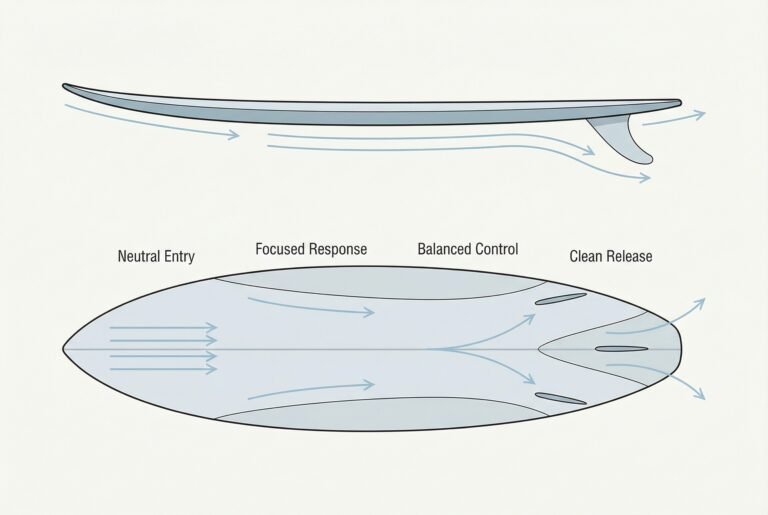
Most boards don’t rely on a single contour.
More often, they blend shapes:
Flat entry
Single concave under the chest
Double concave through the fins
Vee off the tail
The board isn’t one shape, it’s a sequence of responses.
Each transition prepares the next.
How Weight Brings the Board to Life
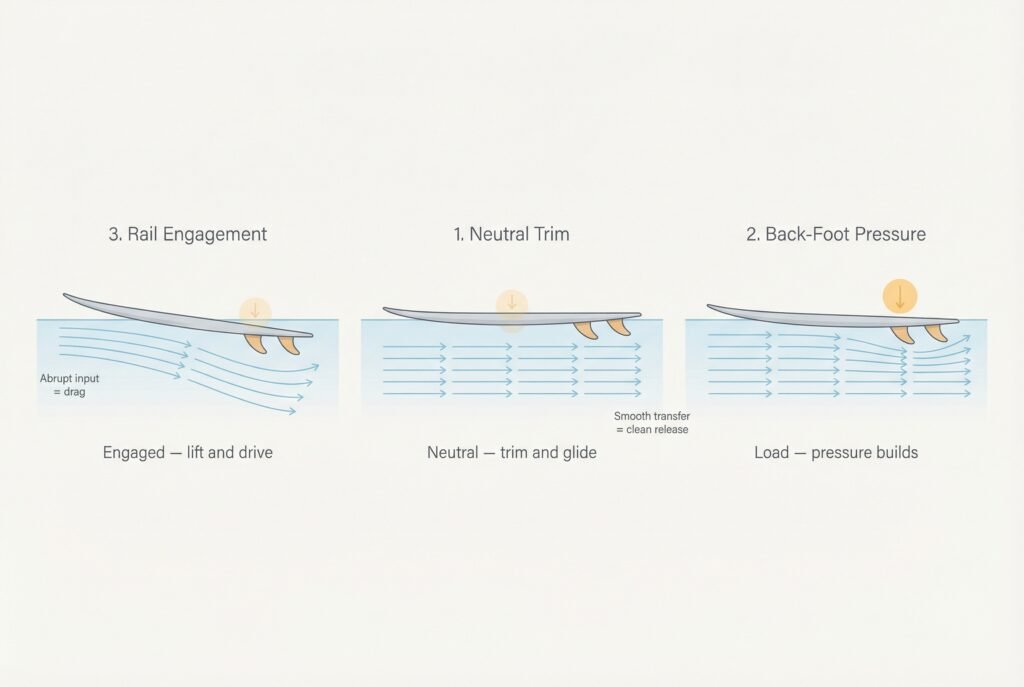
A board remains neutral until pressure is applied.
A neutral stance allows trim.
Back-foot pressure increases load.
Rail engagement builds lift and direction.
The board responds to:
How much weight
Where it’s applied
How smoothly it’s transferred
Abrupt pressure creates drag, clean pressure creates drive.
This same pressure-loading process activates the fins — once water has already been shaped by the board.
Rails: Where Engagement Turns Into Release
If bottom contours decide how water moves under the board, rails decide how that water leaves it.
Rails are not passive edges.
They are active boundaries.
They determine:
How long water stays attached
How much pressure can be held
How cleanly that pressure is released
This is why two boards with the same outline can feel completely different underfoot.
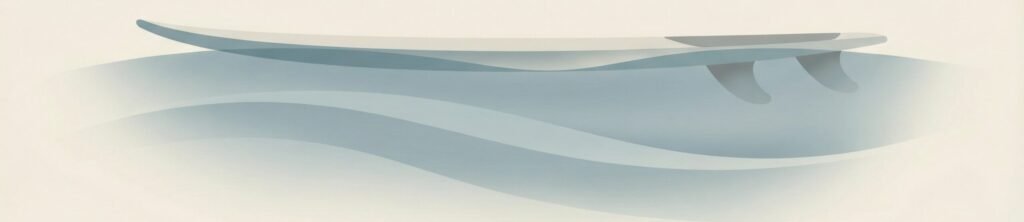
Rails are less about grip and more about time.
How long engagement lasts.
How quickly response arrives.
How abruptly release occurs.
A rail that holds too long feels sticky.
A rail that releases too early feels nervous.
Good rails feel invisible
because their timing matches the surfer.
Soft rails allow water to wrap gradually.
Engagement builds slowly.
Release is forgiving.
They feel calm and predictable.
They let small mistakes dissolve.
They buy time.
Hard rails introduce a defined edge.
Water cannot wrap around them.
Pressure builds quickly.
Release is sharp and decisive.
They feel precise and fast.
They reward commitment and expose hesitation.
Most modern boards blend these qualities.
Tucked edges allow:
Soft engagement at low angles
Hard release when pushed
The rail adapts as the board is driven harder.
Rails are also volumes, not just edges.
Boxy rails float higher and engage later.
Foiled rails sink more easily and respond earlier.
Neither is better.
They simply change effort and feedback.
Rails never work alone.
Concaves feed rails.
Rails release water.
Fins translate the result.
Boards are systems.
Nothing acts in isolation.
Rocker: Timing the Conversation with the Wave
Rocker controls when a board engages.
Flatter rocker trims earlier.
More rocker fits steeper pockets.
Too much rocker creates drag.
Too little reduces adaptability.
Good rocker feels invisible.
Poor rocker is always noticeable.
Entry rocker influences commitment.
It affects:
How early the board fits into the wave
How forgiving take-offs feel
Tail rocker influences direction.
It affects:
Turn radius
Release
How much effort direction changes require
Every rocker choice is a trade-off.
There is no free speed.
Only balance.
Stringers and Flex: The Feel of Feedback
Stringers don’t make boards fast or slow.
They change timing.
Stiffer boards respond instantly – Flexible boards delay return.
One feels sharp, while the other feels smooth.
Flex is personal.
It depends on:
Applied weight
Power
Style
Wave type
There is no ideal flex. Only appropriate flex.
The Full Loop
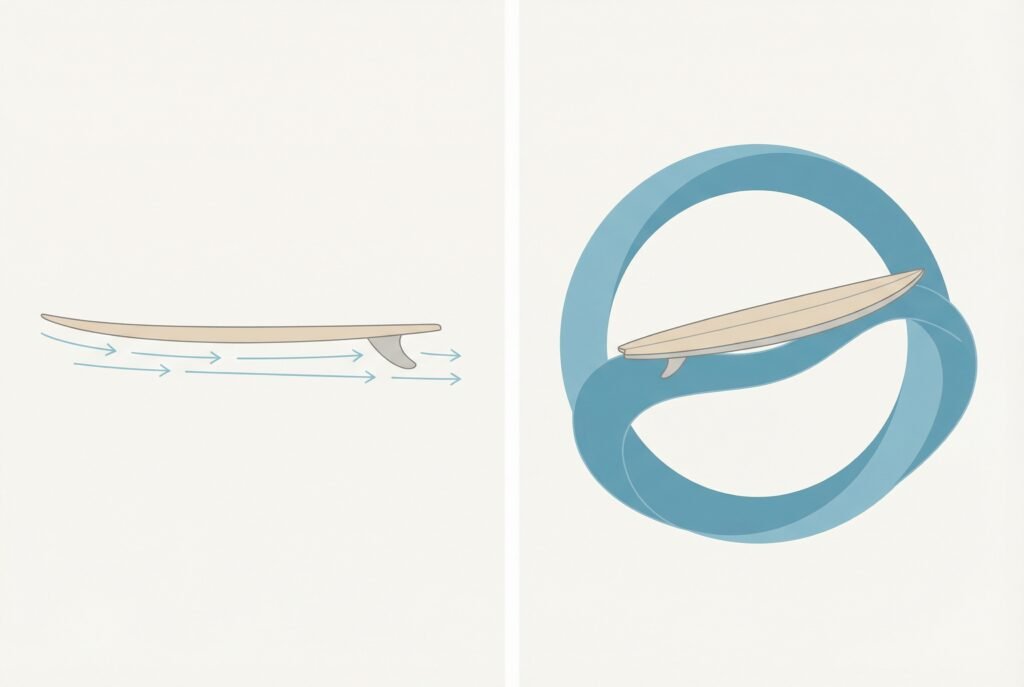
Surfing is a continuous feedback loop.
Human movement becomes board angle.
Board angle shapes water flow.
Water flow activates fins.
The wave supplies the energy.
When everything aligns:
Design disappears
Movement feels natural
The board stops feeling technical
Closing
There is no perfect board.
There is only a surfer, a wave and a design that allows the two to communicate clearly
When that communication is clean,
the board doesn’t feel fast.
It feels right.