BRUCE ELLIS
Surfer · Photographer · Author

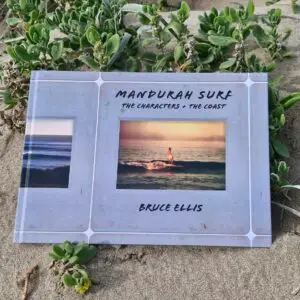
Mandurah Surf: The Characters & the Coast


Prefer to listen?
Bruce Ellis didn’t set out to write a surf book for attention or nostalgia. What drove him was a growing sense that something important was slipping away.
Growing up in Mandurah, Bruce was one of the younger surfers in the area, watching the older crew, and absorbing a culture that existed almost entirely through memory. Years later, as Mandurah was increasingly written off in the media and the coastline itself began to change, he realised that if those stories weren’t captured soon, they’d be lost altogether.
That realisation became the foundation for Mandurah Surf: The Characters & the Coast — a 197-page coffee-table book built from conversations with about 50 local surfers, spanning generations. Rather than focusing on a single figure, the book treats the collective as the character: the surfers, the places they surfed, and the unwritten rules that held everything together.
Place plays a central role throughout the book. Different stretches of coast shaped different surfers. Falcon produced the chargers. Other areas fostered barrel riders, competitors, and cruisers. Geography wasn’t just a backdrop — it actively shaped surf style, attitudes, and rivalries.
While gathering stories, Bruce was repeatedly surprised by how much he didn’t know — even about the place he grew up in. Different surfers remembered the same events in different ways. Friendly rivalries blurred facts. Stories had to be cross-checked, challenged, and pieced together slowly. That process became one of the most demanding parts of the project, but also one of the most rewarding.
One story in particular stayed with him. A couple of young surfers — who were supposed to be at school — paddled out and discovered part of a body floating in the water. They brought it in, ran for help, spoke with police… then paddled back out before heading off. It’s confronting, surreal, and deeply human — the kind of story that never makes the news, yet says everything about the era.
Through these conversations, Bruce also uncovered how dramatically the coastline has been reshaped over time. The removal of sand dunes, combined with increased coastal infrastructure and development, fundamentally altered natural sand movement. On top of that, the opening of the estuary — the Cut — changed how sand flows along the coast, permanently impacting banks, breaks, and consistency. Waves that once worked reliably disappeared or stopped behaving the way they once did. These weren’t abstract environmental changes — they directly affected how, where, and even if people could surf.
Despite that loss, Bruce remains optimistic. He sees a strong new generation coming through — groms filling the lineup with energy and talent. His hope is that by understanding the history, they’ll carry forward the respect that defined earlier generations: respect for elders, for place, and for the water itself.
Throughout the interviews, Bruce kept returning to one idea: surfing in Mandurah has always been a tribe. Not in a romantic sense, but in a practical one. Elders were known and respected. Lineups were regulated by unspoken rules. That shared understanding created safety, order, and belonging. For Bruce, documenting these stories wasn’t just about waves or history — it was about preserving the values that held the tribe together.
On a personal level, writing the book deepened Bruce’s own connection to Mandurah. After years away, it reminded him why he cares so fiercely about the place. The coast, the people, and the shared history aren’t just memories — they’re living threads that still run through the lineup today.
Mandurah Surf: The Characters & the Coast isn’t nostalgia.
It’s continuity.
And Bruce Ellis isn’t trying to preserve surfing as it was —
he’s making sure it isn’t forgotten.